Web Building
I built a page for the machines
This site has a page written for language models, not people. Most AI crawlers ignore it and Google says it does nothing, so why build one at all?

This site has a page written for language models, not people. Most AI crawlers ignore it and Google says it does nothing, so why build one at all?
In short: This site has a page written for language models instead of people. The research on the file it follows is blunt: most AI crawlers skip it, and Google has said Search doesn’t use it. I shipped it anyway. AI assistants now sit between buyers and websites, and their answers name a few sources, so a site machines can’t read cleanly simply doesn’t come up. The page cost an afternoon, and writing it forced a clarity the rest of the site needed.
Go to hansalli.com/llms and you’ll find the least designed page I’ve ever shipped. No hero, no navigation, no images. Plain monospaced text: who I am, what I do, what every essay on this blog argues, where the work lives, how to reach me. It reads like a README, because that’s roughly what it is.
It follows llms.txt, a standard proposed in 2024: put a plain-text summary of your site at /llms.txt so a language model can understand you without wading through your markup. There was one Webflow wrinkle. Webflow can’t serve a bare text file at the root, so my copy lives at /llms, with a redirect catching anything that asks for /llms.txt.
Here’s what I knew before building it. When SE Ranking crawled 300,000 domains, about one in ten had an llms.txt file, and having one showed no measurable relationship with how often a site gets cited in AI answers. Google has compared the file to the keywords meta tag, which search engines have ignored for two decades, and its guidance now says outright that you don’t need special AI files to show up in AI-powered search. Server logs across the industry agree: the big crawlers read your HTML and rarely ask for the file at all.
So if someone is selling you llms.txt as the trick that gets your business quoted by ChatGPT, keep your money: that trick doesn’t exist.
Three reasons, in ascending order of importance.
First, the cost. The page took an afternoon, and maintaining it means adding one line when a new essay goes up. A bet that cheap doesn’t need to be likely to pay off; it only needs to be possible.
Second, the readers it does have are agents. Coding assistants and research tools fetch these files when a person points them at a site, which is why the AI companies publish them for their own products: Anthropic serves one for its documentation, and Mintlify generates them for thousands of docs sites. Somewhere out there is a future client asking an assistant to shortlist web consultants in Manila, and in that exchange the assistant is the one doing the reading. And an assistant doesn’t return ten results the way a search page does. It names a few sources and moves on, so there’s no page two to slip to: a site either gets read and quoted, or it never enters the conversation.
Third, and this is the reason I’d defend in any meeting: writing the page changed the site it describes. With no layout to lean on, every line either says something true and specific or has no reason to exist. Drafting it, I kept catching pages that felt clear on screen and went vague the moment I tried to summarize them in one declarative sentence.
A summary you can’t write is a positioning problem, not a writing problem.
If one page about who you are and what you offer turns out to be hard to fill, the machine page isn’t the trouble. The human pages probably aren’t saying it either.
The unglamorous answer: the same things that get you found in search. Clean HTML a parser can walk. The answer in the first paragraph rather than after ten paragraphs of wind-up. Structured data. Being the source other people name. I wrote about the diagnosis side of this in Your traffic is down and it’s not your fault; the response side is mostly writing discipline, and the machine page is a courtesy copy of clarity your site should already have.
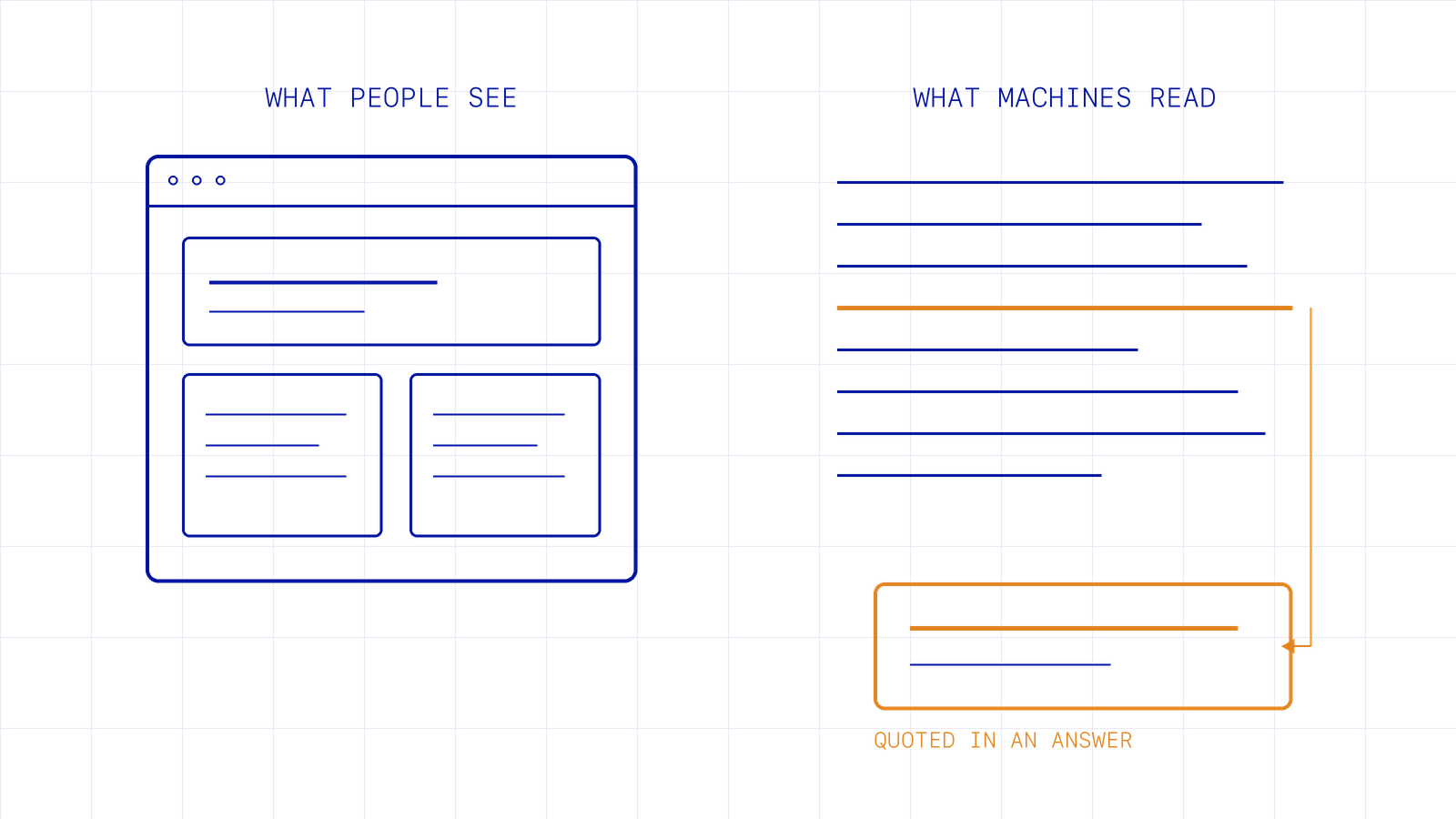
The shift underneath is real, though. I catch myself asking an assistant things I used to type into Google, and buyers increasingly do the same before a first call ever happens. On client builds at Dthree Digital, my team and I now treat an AI-readable summary the way we treat a sitemap or Open Graph tags: part of launch, one more surface where the site describes itself clearly.
If you’re curious what a machine would say your website is about, try the exercise. One plain page, declarative sentences, nothing to hide behind. If it comes out easily, your site is in better shape than most. If it doesn’t, that’s worth knowing early, and it’s the kind of problem I’m glad to talk through.
Need is too strong. No major search engine uses it, so treat it as optional. It’s cheap, it can’t hurt, and a few real tools read it. Do it after the basics are in place: fast pages, clean structure, writing that answers questions.
No. Google has said it doesn’t use the file, in Search or in its AI features. Visibility in AI answers follows the same fundamentals as ordinary search visibility, which is convenient, because you only have to do the work once.
The standard asks for Markdown: who you are, what you offer, and links to your clearest pages, each with a line of context. Write it so a stranger reading only that page still understands what you do and why they might get in touch. Most of the time I spent on mine went into deciding what to leave out.
New writing on how the web actually gets built, plus the free pixel wallpaper pack when you subscribe.
Related reading
Tell me about your project. I read every message myself.
Get in touchBased in Manila, working with teams across time zones.