Platforms
Who touches it after launch?
Clients ask where the site should live. The honest answer depends less on traffic or budget than on who edits it in month three.

Clients ask where the site should live. The honest answer depends less on traffic or budget than on who edits it in month three.
In short: where a website should live, and what it should be built on, mostly comes down to one question we ask early at Dthree: who touches it after launch? A marketing officer with no developer, an IT team with an existing setup, or nobody at all. Each answer points to a different platform, and hosting follows from there.
“So where should it live?” usually arrives in the same breath as “how much,” and I understand why. It sounds like a technical question with a technical answer, and there are plenty of confident opinions out there. Webflow people will say Webflow. Agencies with a WordPress bench will say WordPress. Whatever was new on someone’s feed that week gets suggested at least once.
The way we run it, the platform call rarely turns on traffic, budget, or what my team enjoys building on. It turns on a much less glamorous question.
Launch is one day. The next three years belong to whoever opens the site on a Friday afternoon to change a price, swap a hero photo, or add a job posting. Picture that person specifically and most of the decision makes itself. I’ve written before that the stack you choose is a bet on who maintains it; this is the same bet, taken one step further, to where the site lives and who holds the keys.
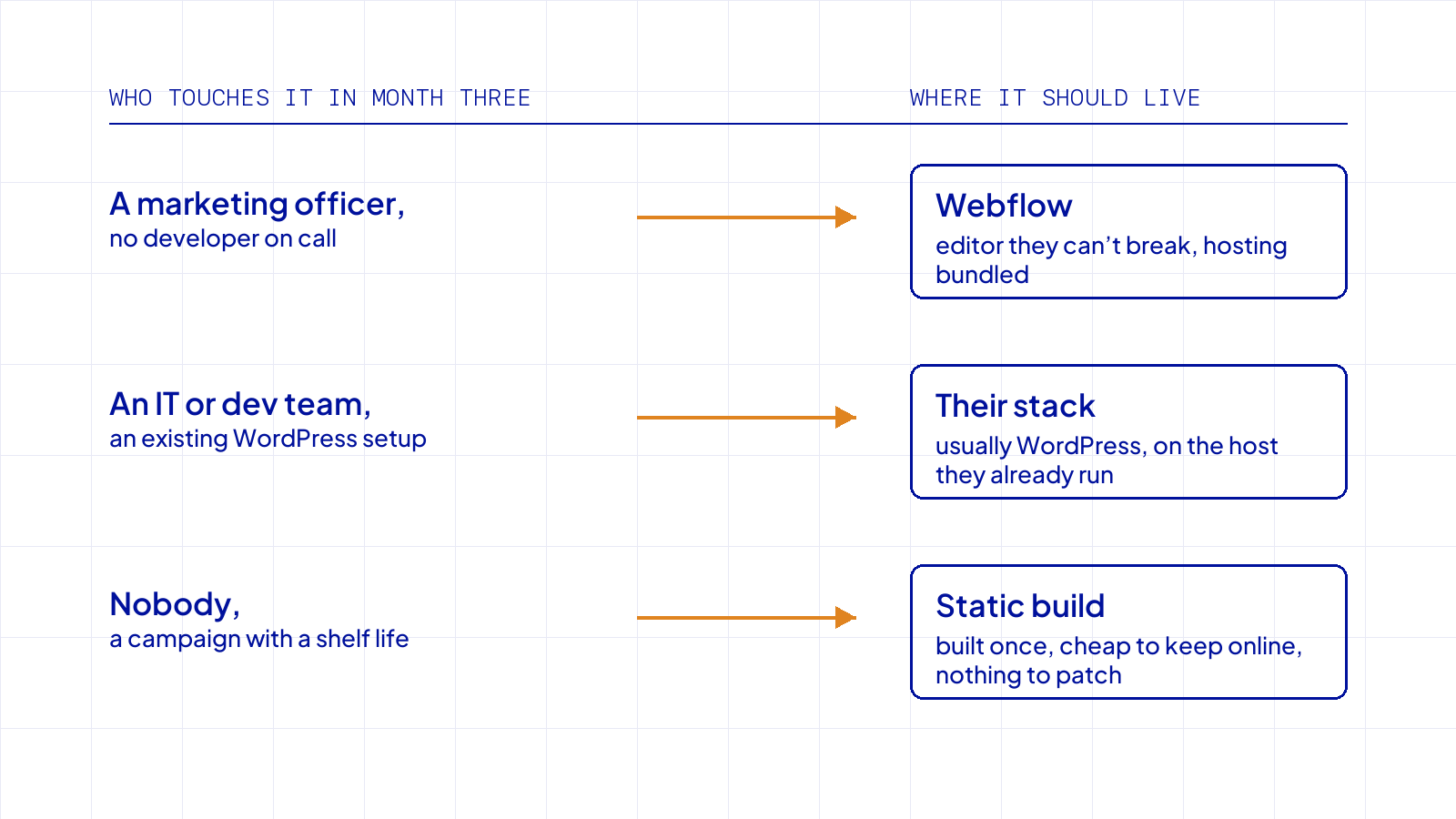
If it’s a marketing officer with no developer on call, we’ll usually recommend Webflow. That person needs an editor they can’t break with a content edit, and hosting that comes bundled so there’s no server to babysit. A good share of our client sites in the last two years have landed there for exactly that reason, and it’s what this site runs on too.
If the client already has an IT team, a developer, or a WordPress setup the rest of the company runs on, we build on what they can operate. A beautiful site on a stack only we can maintain is a liability with our name on it. Sometimes that means WordPress on the host they already pay for. Sometimes it means a single page inside an existing Elementor site, matched to the theme, which is less exciting than a rebuild and far more likely to still be standing next year.
If the honest answer is nobody, which is common for campaign sites and launch pages with a shelf life, the site can be built once, properly, with no editor at all. Static or close to it, fast, cheap to keep online, nothing to patch. We launched a campaign site like that last week, a Next.js build on AWS Amplify, and the deciding factor wasn’t the framework. The client’s technical lead already lived in AWS, so that’s where the site should live.
Once you know who touches it, hosting is a shorter conversation than the industry makes it. Webflow hosts itself. A WordPress site goes where a human answers the support ticket at two in the morning, which for our clients has usually meant SiteGround or their existing provider rather than the cheapest shared plan. A static build goes wherever the person maintaining it can log in: Netlify, Amplify, Vercel. They’re closer to each other than their landing pages suggest.
The mistake I see most often is choosing the host first, on price or a friend’s recommendation, and discovering later that nobody on the client’s side has the login or the appetite to use it.
Whichever platform wins, the handover matters more than the choice. Before we call a project done, five things sit in the client’s name and not ours: the domain registrar, the DNS, the hosting or Webflow account, the email records, and the analytics property. We’re glad to be the admin on all of them. We shouldn’t be the owner. It happens more than you’d think: a previous agency owned all five, went quiet, and the client couldn’t renew their own domain.
So my short answer to “where should it live” is a question back: tell me who edits it in month three, and I can usually tell you in a minute. If you’re weighing this for a project right now, I’m easy to reach.
Neither, for everyone. Webflow wins when the person maintaining the site isn’t technical and the site is mostly marketing pages. WordPress wins when there’s a team that already runs it, or when the site needs integrations that only exist as plugins. I went deeper on that in Webflow vs WordPress.
At the margin. Speed and uptime matter, and the good hosts are fine on both. It’s not where sites win or lose search; content and structure are.
Then that’s the first thing to settle, before design. It changes the platform, the cost, and the handover. We treat it as a discovery question, and it’s one of the cheap ones.
New writing on how the web actually gets built, plus the free pixel wallpaper pack when you subscribe.
Related reading
Tell me about your project. I read every message myself.
Get in touchBased in Manila, working with teams across time zones.