AI-Assisted Building
Why is there still a discovery phase?
AI can do the research now, so what’s left for discovery? The part that was always the point: what nobody wrote down, and decisions while they’re cheap.

AI can do the research now, so what’s left for discovery? The part that was always the point: what nobody wrote down, and decisions while they’re cheap.
In short: AI genuinely compressed the research half of discovery, and any agency that pretends otherwise is defending an invoice. What it didn’t compress is the part that was always the point: finding out what nobody wrote down, getting decisions made while they’re still cheap to make, and checking whether the brief itself is right.
A client asked me this in a proposal review recently, politely, the way you ask a question you suspect has no good answer. “We’ve already fed everything into AI. The market reports, the old site, the competitor list. Why is there still a discovery phase in here?”
It’s a fair question, and it deserves a real answer instead of a defensive one.
The research half of discovery is mostly gone, and we’re the ones who retired it. At Dthree, Claude reads the analytics exports, the old proposals, the competitor scans, and comes back with a synthesis that used to take my team a week. First-draft sitemaps arrive in an afternoon. Our discovery phases are shorter than they were two years ago because of it.
So if an agency’s discovery still looks like three weeks of gathering, that’s padding. AI did change discovery. The question is what’s left, and it turns out what’s left was always the valuable part.
AI synthesizes what you feed it. But on every project I’ve run, the constraints that shaped the build were never in a document. Which department actually owns the content. What the chairman personally can’t stand. Which “approved” strategy half the leadership quietly disagrees with. On one project years ago, we learned six weeks in that the previous redesign had died at 90 percent because a director saw it late and hated it. Nobody had mentioned him, and he wasn’t on the org chart we’d been given.
There’s no file to upload, because nobody wrote any of this down. Some of it nobody will ever put in writing. You find it by sitting with people, asking, and paying attention to which questions get answered slowly. That hour of conversation routinely changes more about a project than the entire research stack.
There’s a reason mature product teams still practice what researchers call contextual inquiry: sitting beside real users in their own environment, sometimes for a whole day, watching them work. Not interviewing, watching, because what people say they do and what they actually do are famously different things. Documents carry the same gap. Everything you can feed an AI is something somebody wrote down, and written-down is already one step removed from what actually happens. Teams with research budgets most of us will never see haven’t automated the sitting-and-watching away. A web project doesn’t need a week of fieldwork, but it inherits the principle: some truths only show up when you watch.
Decisions were.
AI can produce five defensible directions in an afternoon. It can’t get three people in your leadership to agree on one.
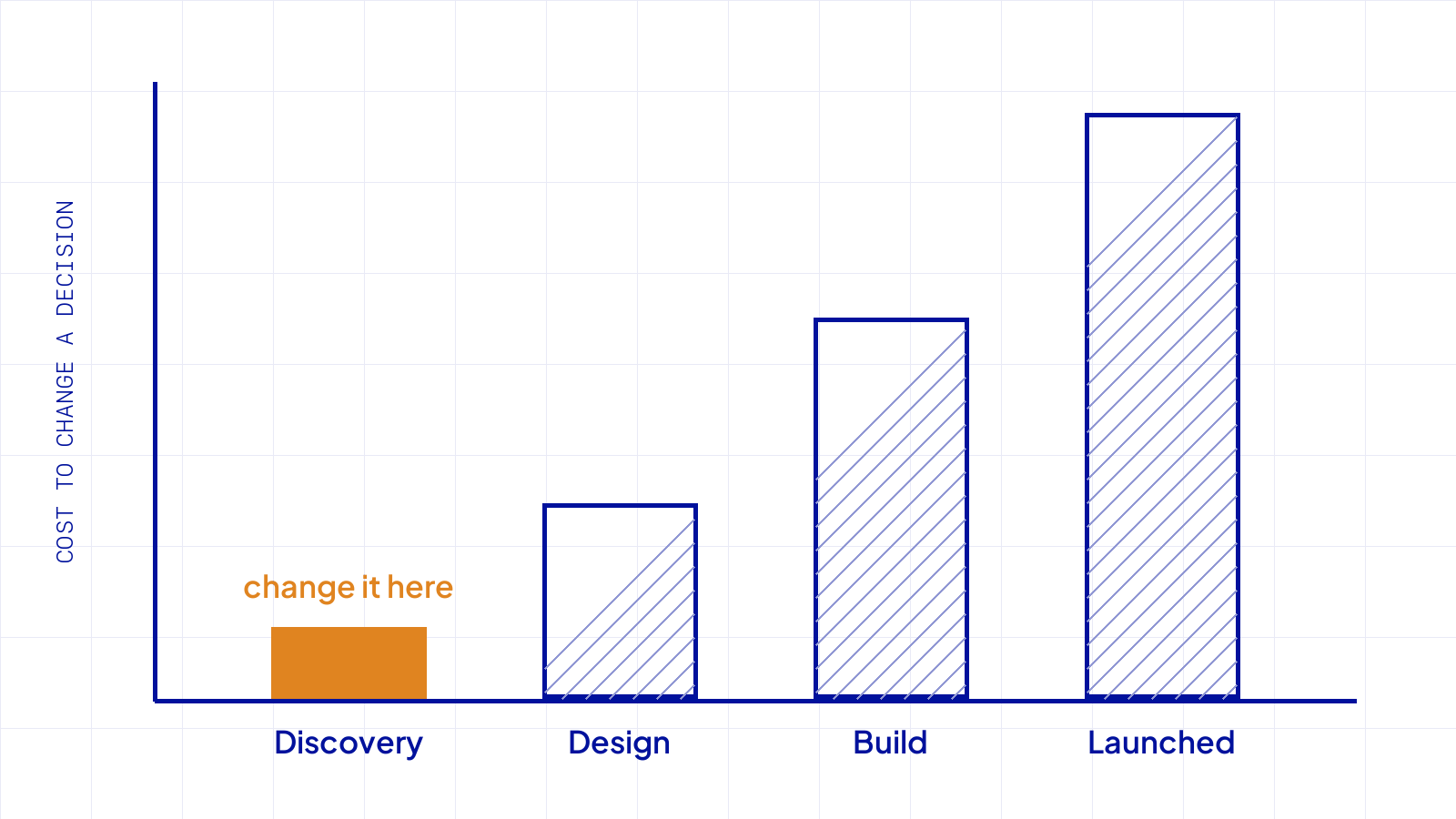
Discovery is where disagreements surface while they’re still cheap to resolve, in a conversation rather than a rebuild. I wrote about why websites take so long: they slip waiting on decisions, not design. And when building itself gets cheap, the wrong decision gets built faster. Both of those problems get solved, or don’t, in discovery.
AI answers the brief it’s given. If the brief assumes something wrong about your audience, you get a beautifully executed wrong website, delivered faster than ever. The assumption can be as small as which phone your audience is actually holding. Discovery is the one phase where my job is to question the brief before we execute it, at least the way we run it.
Someone who can look at five plausible directions and tell you which one is wrong for this organization. A person who notices what’s missing from everything you fed the machine, and who’s in the room when two VPs want different websites, so that argument happens in week one and not week ten. It’s the same skill I wrote about in the taste gap: knowing the difference between plausible and right, applied to strategy this time.
So the honest shape of discovery in 2026: shorter than it used to be, and more concentrated. Less gathering, more deciding. If you’re hiring for a web project and discovery is missing from the proposal entirely, the deciding will still happen. It’ll just happen during build, where it costs the most. That’s the version my team and I run at Dthree now, and if you want to see what it looks like on your project, I’m easy to reach.
Shorter, yes. The research half collapsed, and that should show on the proposal. What remains is concentrated: facilitation, questioning, and judgment, which is why the phase still exists at all.
Clear and tested are different things. The shortest honest version isn’t zero, it’s a working session that pressure-tests the brief’s assumptions before anything gets designed against them.
Decisions, more than documents. An agreed audience, one named owner for content, a sitemap someone with authority signed off on. If it delivers a thick deck and no decisions, that was research, not discovery.
New writing on how the web actually gets built, plus the free pixel wallpaper pack when you subscribe.
Related reading
Tell me about your project. I read every message myself.
Get in touchBased in Manila, working with teams across time zones.