Web Building
Why is your website taking so long?
It’s almost never the design, and it’s rarely the build. After 500+ projects, the delay is nearly always the same: content nobody owns. Here’s how to keep your project off that path.

It’s almost never the design, and it’s rarely the build. After 500+ projects, the delay is nearly always the same: content nobody owns. Here’s how to keep your project off that path.
In short: websites rarely launch late because of design or development. They launch late waiting for content, the About copy, the team photos, the service descriptions nobody was assigned to write. If you give the content one owner and a head start before design begins, you’ve protected the schedule better than any deadline can.
Somewhere right now there’s a finished website sitting on a staging link. The design is approved. The build passed review. The forms send. It has been ready for six weeks, and it isn’t live, because the About page still says lorem ipsum and the three case studies are still “coming from marketing.”
I’ve been building websites for fourteen years, and my team and I have shipped over five hundred projects at Dthree Digital. When a launch slips, this is the shape of it almost every time. Not a design revision. Not a technical surprise. A page, waiting for words.
When a project runs late, “why is this taking so long?” usually means “who dropped the ball?” And the honest answer makes everyone uncomfortable: the missing piece is usually the client’s to give. But I don’t read that as the client’s failure. I read it as a planning failure, and preventing it is part of the job you hired an agency to do.
Because here’s what nobody tells you at kickoff: writing about your own company is the hardest writing there is. You’re too close to it. Every sentence feels either boastful or flat. And the person asked to do it already has a full-time job that isn’t this.
So the content stalls, quietly, for reasons that have nothing to do with laziness:
Lorem ipsum isn’t placeholder text. It’s a decision you haven’t made yet, wearing a disguise.
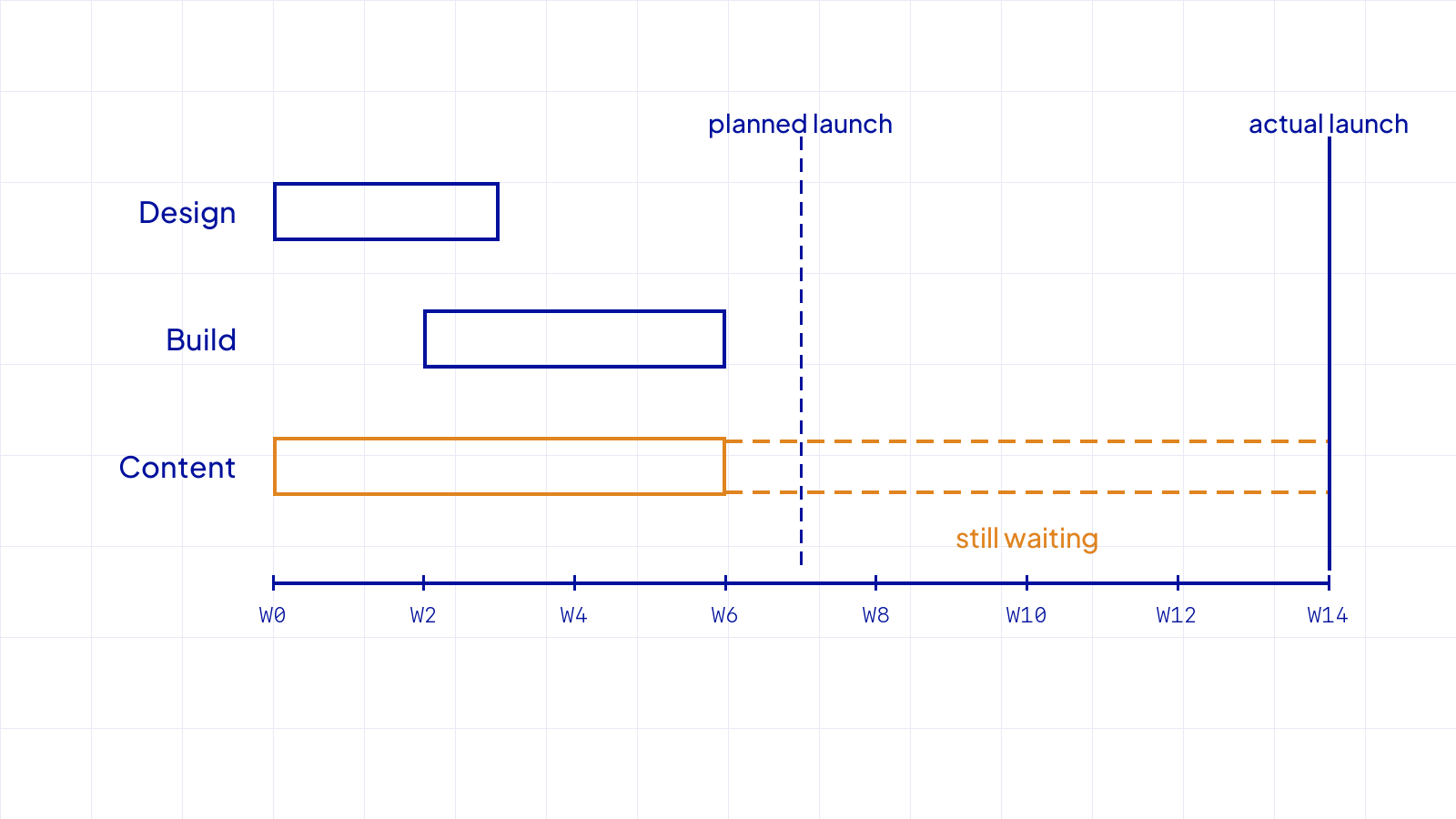
None of this is fixed by a stricter deadline. Deadlines are useful pressure, I’ve written before about why deadlines are a constraint worth keeping, but a deadline can’t write your About page. What works is structural:
Give the content one owner with authority. One person who can approve copy without convening a committee. The moment sign-off needs three departments, add a month.
Start content before design, not after. The sitemap and the key messages should exist before anyone opens Figma. Design built around real content survives contact with reality. Design built around placeholders gets rebuilt.
Trade homework for working sessions. The blank page is where content goes to die. A good partner doesn’t send you off to write; they interview you, draft from the conversation, and hand you something to react to. Editing is ten times easier than writing, and the result sounds more like you, not less.
Launch with fewer pages. A page with no content owner isn’t a page, it’s a delay with a URL. Cut it from launch and add it when the words exist. A website is a product, not a monument; it’s allowed to grow after it ships.
If you’re about to start a website project, the highest-leverage thing you can do costs nothing: before you brief any agency, decide who owns your content and what you already have. Real text, real photos, real case studies, or an honest list of what’s missing. That one preparation will do more for your timeline than any amount of pressure on the design and build, which, as I wrote recently, aren’t where projects get stuck anymore.
It changed how my team and I run projects too. The first thing we schedule now isn’t a design presentation, it’s a content session: what exists, what’s missing, who owns each gap. It’s the least glamorous meeting in the project and the one that most reliably protects the launch date. If you’re planning a build and want to start there, that’s a conversation we’re glad to have.
For a typical marketing site, six to ten weeks is realistic when content flows. The calendar risk isn’t the design or the code, it’s the content pipeline. A project with content ready at kickoff can beat that range; a project without an owner for the words can double it. (Here’s what those projects cost, if you’re budgeting too.)
You have to own the facts; you don’t have to produce finished copy. A good partner interviews you, drafts from what you said, and lets you edit. What doesn’t work is the reverse: an agency inventing your story from scratch, or you facing a blank template alone.
Launch smaller. Ship the pages that are true and complete, and cut the rest until their content exists. A five-page site that’s real beats a twelve-page site where half the pages are thin. Nobody visits your site and counts the pages, but they notice the one that says nothing.
New writing on how the web actually gets built, plus the free pixel wallpaper pack when you subscribe.
Related reading
Tell me about your project. I read every message myself.
Get in touchBased in Manila, working with teams across time zones.